Building and Exploring the Reinforcement Learning Knowledge Graph
Overview
Our knowledge graph represents mappings of the RL field , encompassing: - 227 Core Concepts - 67 Distinct Algorithms - 82 Research Papers - 50+ Methodological Approaches - 19 Frameworks - 13 Algorithm Variants - Multiple Specialized Domains
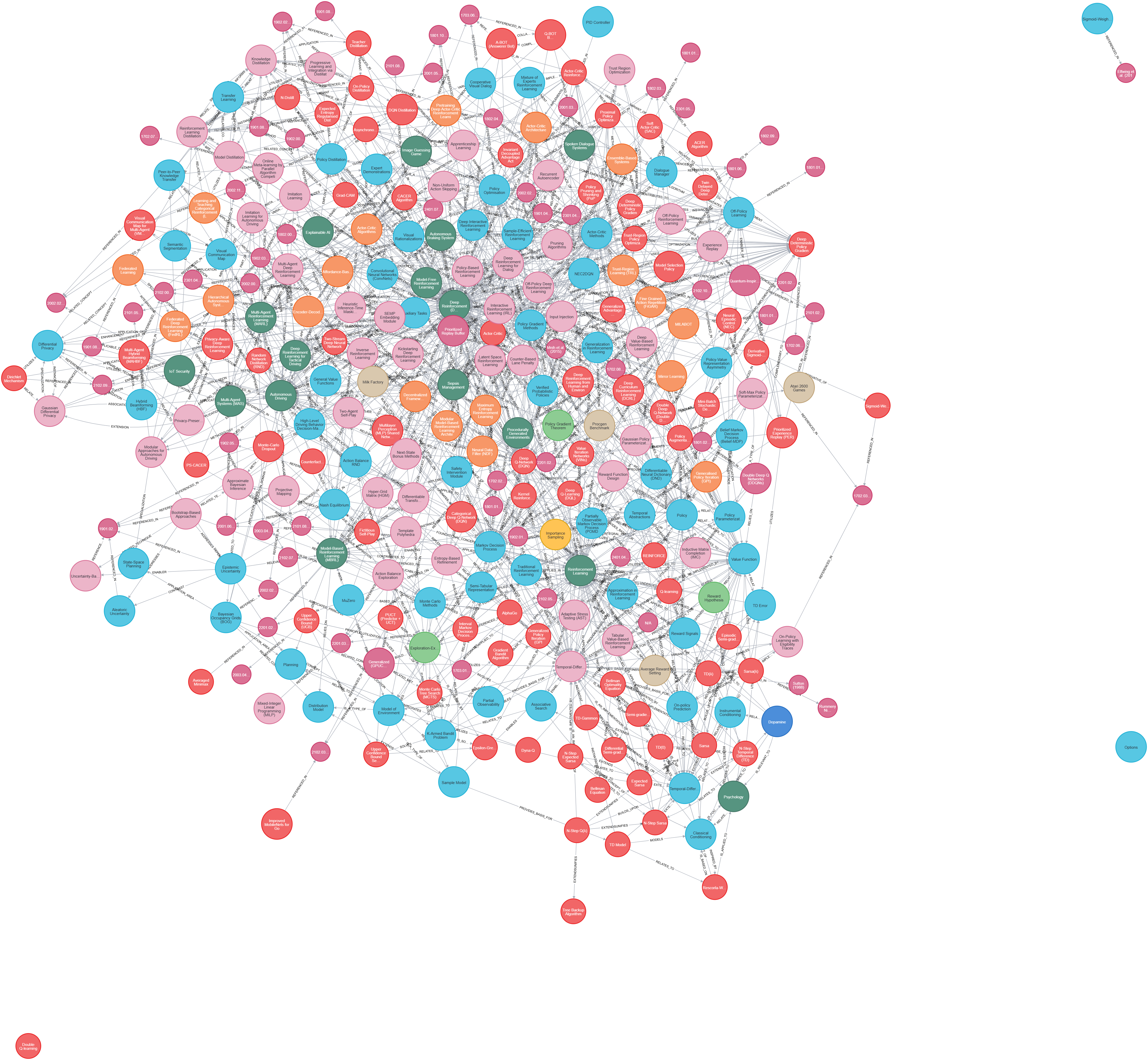
Knowledge Graph Overview
This visualization reveals the dense interconnections between different elements of reinforcement learning.
Neo4j Knowledge Graph Interface: A Visual Guide

Neo4j Knowledge Graph Interface showing the main components and visualization tools
Interface Components
NEO4J Query Bar
Where Cypher queries are entered to interact with the graph database
Currently showing “MATCH(n) RETURN n” which displays all nodes
Export Tools
Provides export functionality in multiple formats:
JSON
PNG
SVG
CSV
Left Sidebar Tools
Graph: Visual graph view selector
Properties View: Displays detailed node and relationship properties in JSON format
Text: Text view option
Code: Code view selector
Node Labels Panel
Displays all node types with their respective counts
Color-coded categories including: - Concept: 227 nodes - Algorithm: 67 nodes - Paper: 82 nodes
Contains 15 distinct node types
Relationship Types Panel
Shows relationship varieties between nodes
Displays 50 out of 245 total relationship types
Key relationships include: - REFERENCED_IN (186 instances) - PROVIDES_BASIS_FOR (22 instances)
Domain and Field Exploration
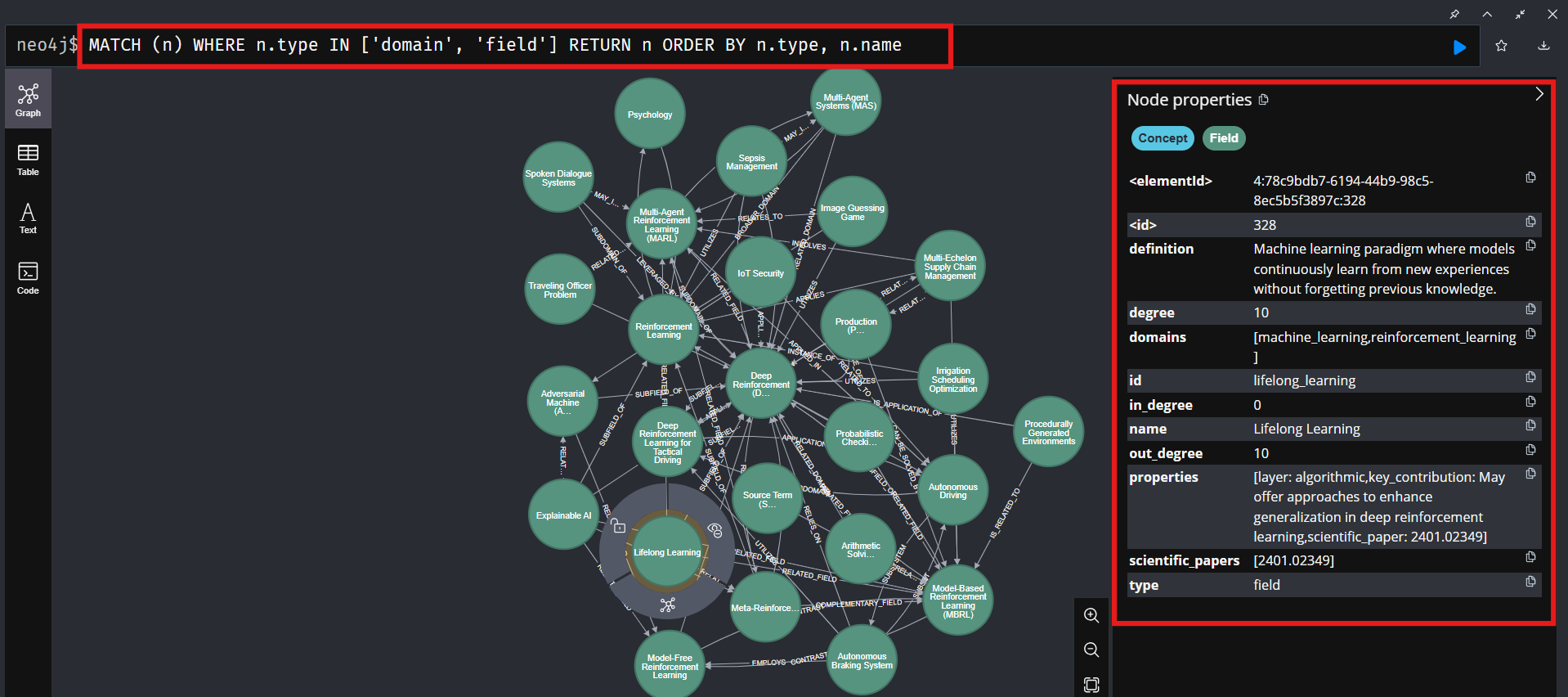
Cypher query showing domain and field nodes in the knowledge graph
The knowledge graph includes various specialized domains and fields where reinforcement learning has been applied. These can be explored using the following Cypher query:
MATCH (n)
WHERE n.type IN ['domain', 'field']
RETURN n
ORDER BY n.type, n.name
Domain Structure Example: IoT Security
IoT Security provides an exemplary case of domain representation in our knowledge graph:
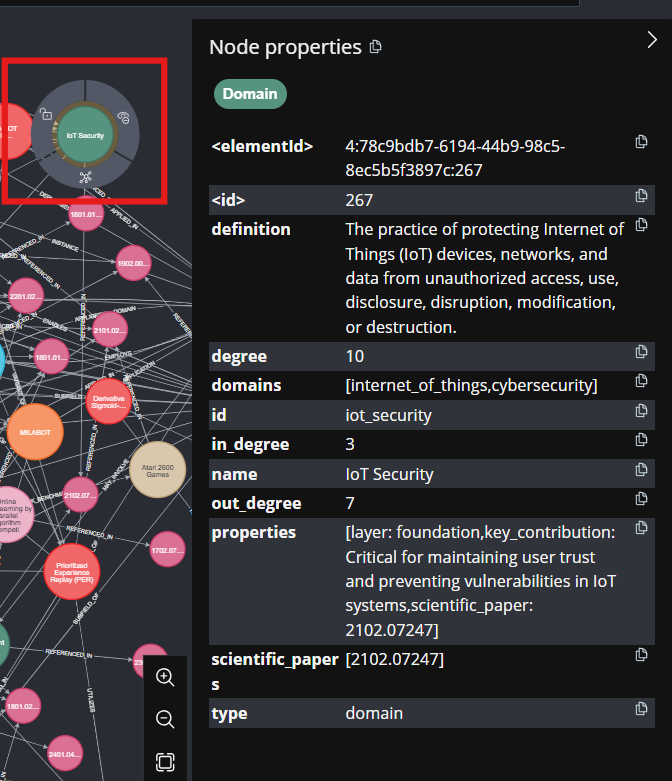
IoT Security Node’s properties
Definition: The practice of protecting Internet of Things (IoT) devices, networks, and data from unauthorized access, use, disclosure, disruption, modification, or destruction.
Connectivity: - Total connections (degree): 10 - Incoming connections (in_degree): 3 - Outgoing connections (out_degree): 7
Properties: - Layer: foundation - Key contribution: Critical for maintaining user trust and preventing vulnerabilities in IoT systems - Scientific backing: Referenced in paper 2102.07247
Key Application Domains
Technical Domains
IoT Security
Multi-Agent Systems (MAS)
Autonomous Braking System
Multi-Echelon Supply Chain
Scientific Fields
Psychology: Intersection of reinforcement learning with cognitive science
Explainable AI
Probabilistic Model Checking
Emerging Applications
Irrigation Scheduling Optimization
Adversarial Machine Learning
Multi-Agent Reinforcement Learning
Algorithm Improvements
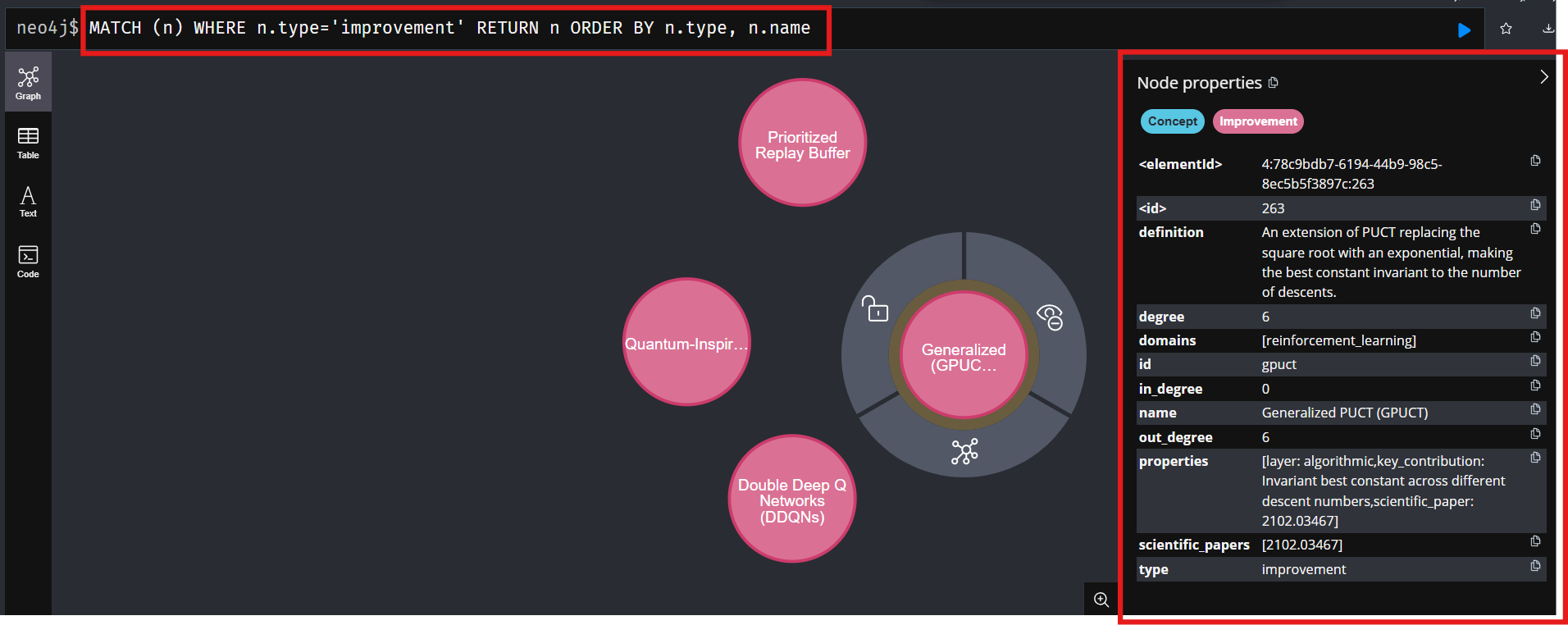
Query showing algorithm improvements and variations in the knowledge graph
improvements and variations can be queried using:
MATCH (n) WHERE n.type='improvement'
RETURN n ORDER BY n.type, n.name
Notable Improvements
Generalized PUCT (GPUCT)
Enhances the PUCT algorithm by replacing square root with exponential
Makes best constant invariant to descent numbers
Referenced in paper 2102.03467
Layer: algorithmic
Prioritized Replay Buffer
Double Deep Q Networks (DDQNs)
Quantum-Inspired Improvements
More Knowledge Graph Node Types with examples
Variant Analysis
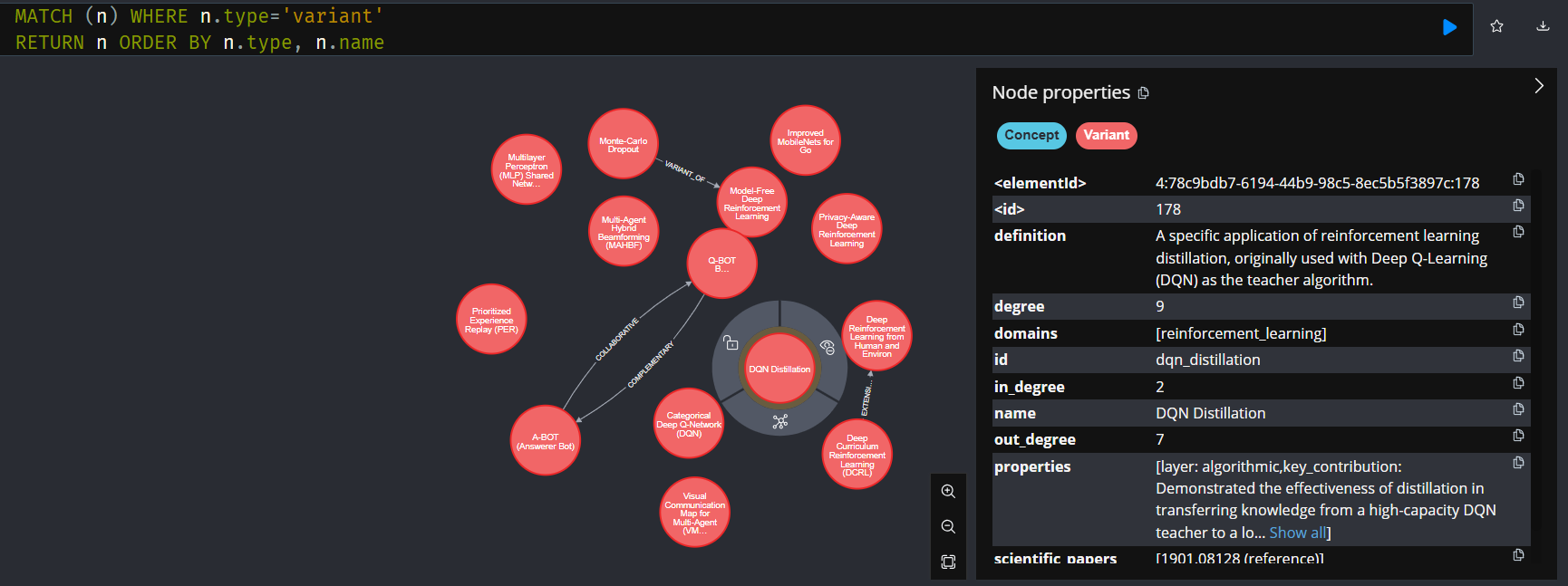
Graph visualization of algorithm variants and their relationships
Querying variants using:
MATCH (n) WHERE n.type='variant' RETURN n ORDER BY n.type, n.name
Shows DQN Distillation as a key example: - A specific application of RL distillation - Used with DQN as teacher algorithm - Has 9 connections (2 in, 7 out) - Referenced in paper 1901.08128
Benchmark Exploration
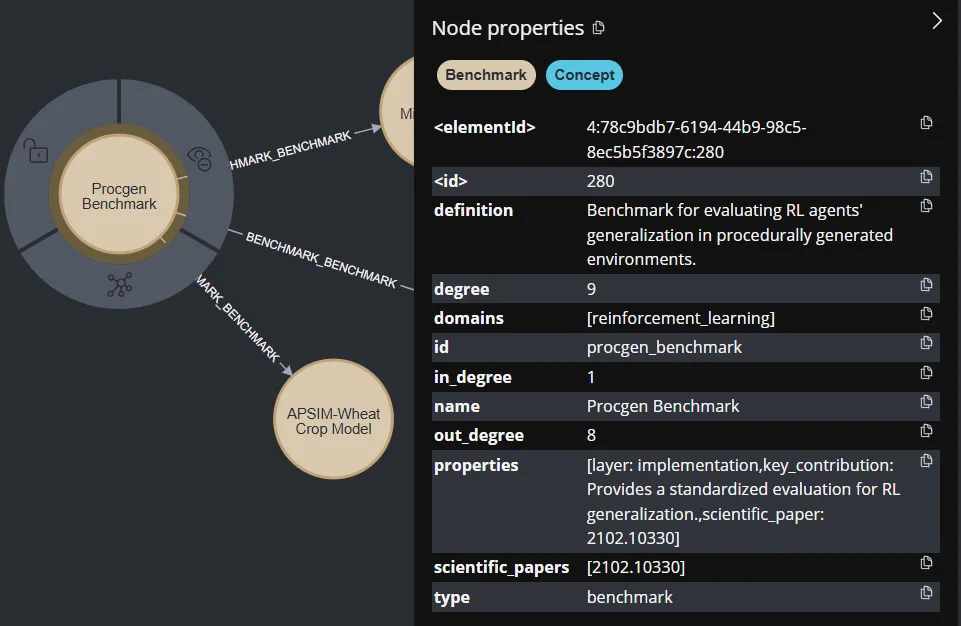
Procgen Benchmark node and its connections
The Procgen Benchmark example shows:
Purpose: Evaluates RL agents’ generalization
Layer: Implementation
Connectivity: 9 total connections
Key contribution: Standardized evaluation framework
Scientific backing: Paper 2102.10330
Algorithm Structure
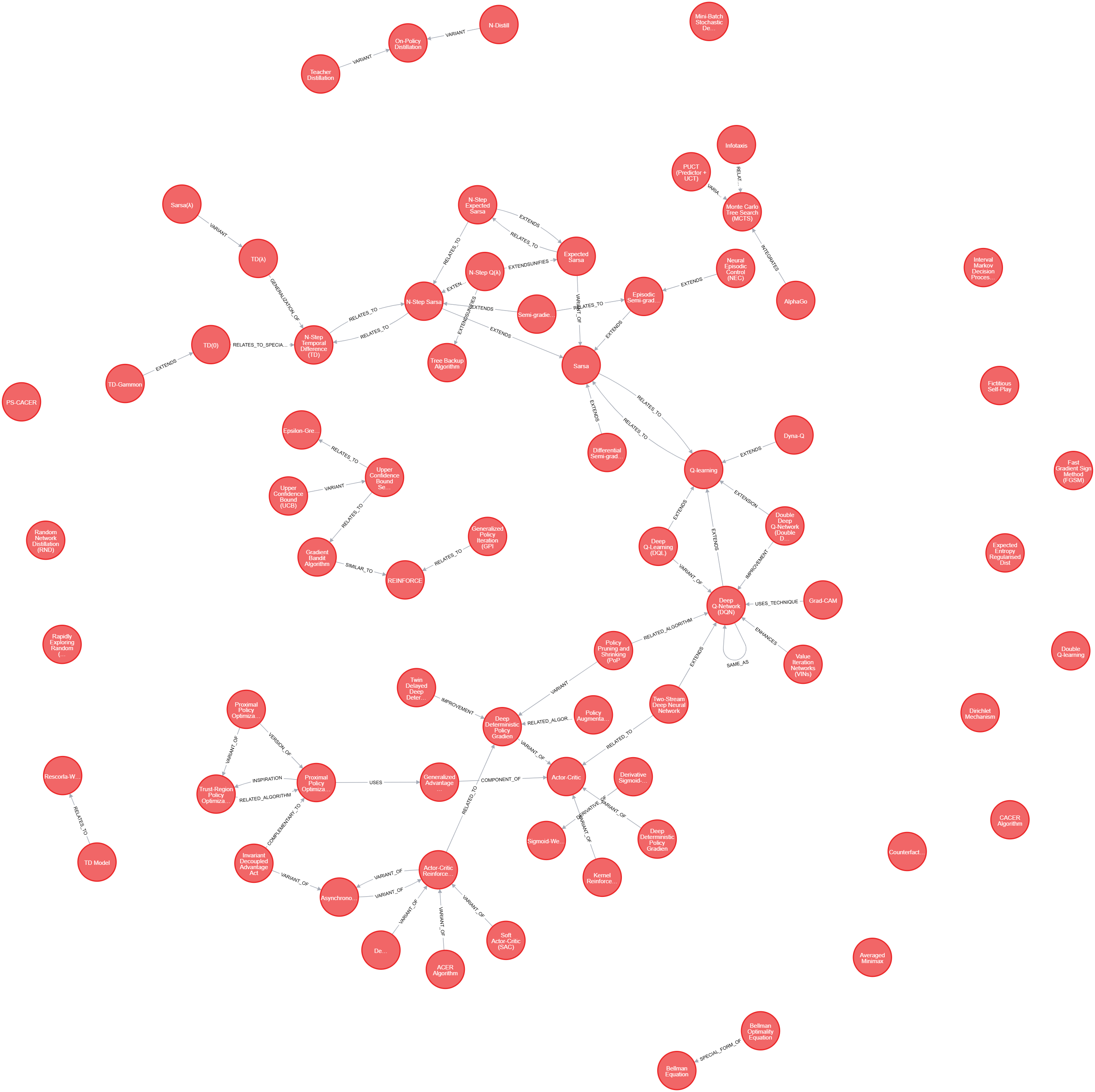
Network of algorithm nodes
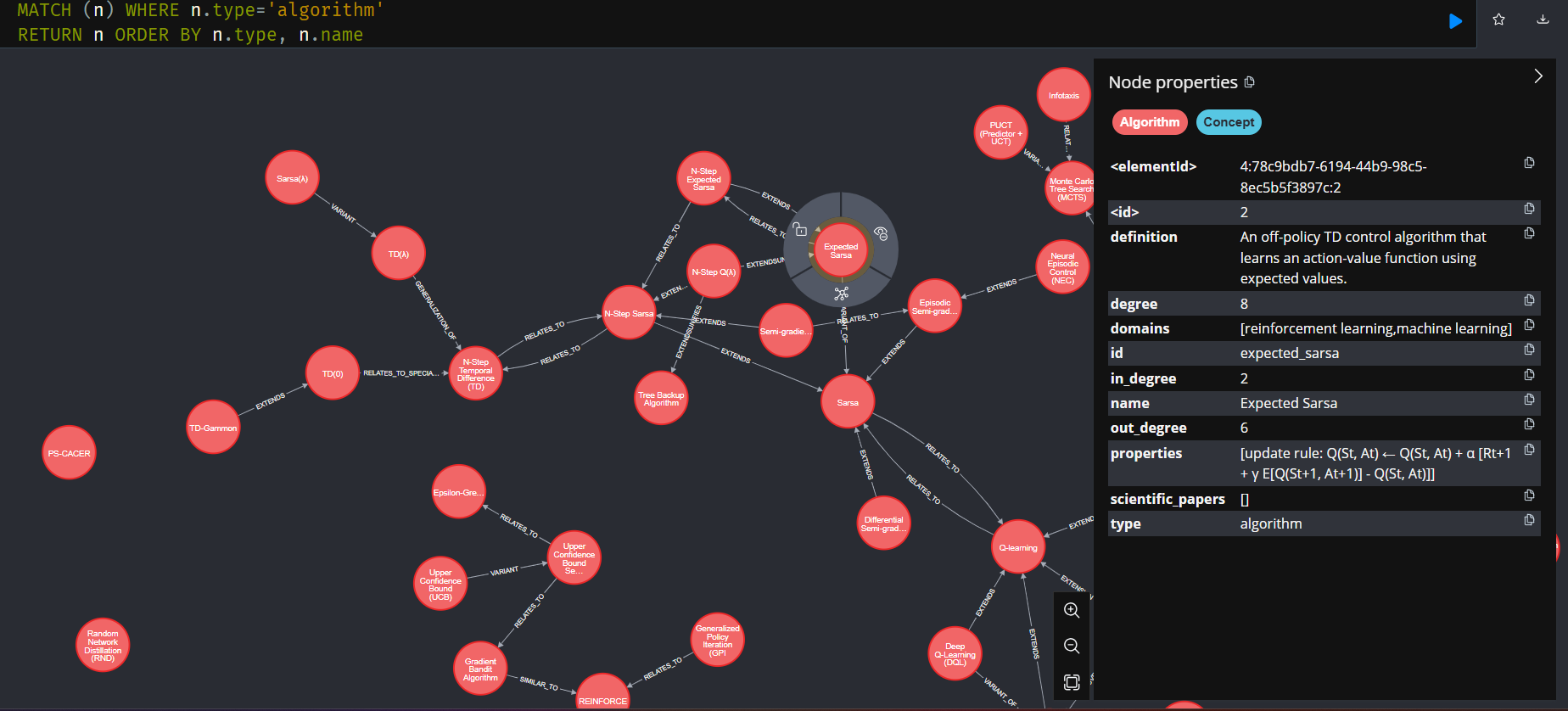
Network of algorithm nodes showing Expected Sarsa and related algorithms
Query reveals algorithm relationships:
MATCH (n) WHERE n.type='algorithm' RETURN n ORDER BY n.type, n.name
Expected Sarsa example: - Off-policy TD control algorithm - Has specific update rule - Connected to multiple variants - Shows clear evolutionary path of algorithms
Method Analysis

Reward Function Design method and its network of connections
Reward Function Design example: - Definition: Process of crafting effective reward functions - High connectivity: 17 total connections (6 in, 11 out) - Layer: Algorithmic - Key contribution: Balances competing objectives - Referenced in paper 1702.02302
Paper Connections

Paper node 1702.03118 and its citation network
Example shows:
Paper ID: 1702.03118
Multiple REFERENCED_IN relationships
Connects different concepts (Explainable AI, Spoken Dialogue Systems)
Shows how papers bridge different domains